


Blog
Four-Wheel Drive Won't Help You Stop: The Winter Overconfidence That Causes Collisions
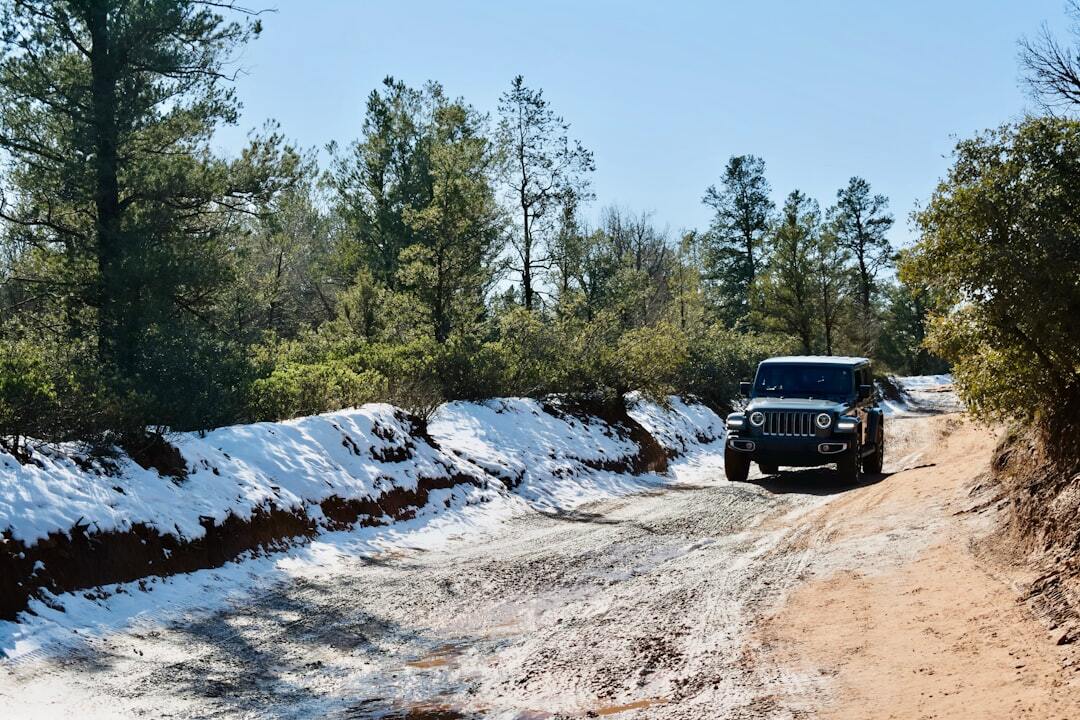
Drive around Show Low, Lakeside, or Pinetop after the first real snow and you will notice something. A lot of the vehicles in the ditch are trucks and SUVs. Not sedans. Four-wheel drive and all-wheel drive vehicles, the ones people buy specifically so they can handle winter up here.
There is a straightforward reason for that, and it is worth understanding before the season gets going, because it is one of the most common and most preventable causes of winter collisions in the White Mountains.
What Four-Wheel Drive Actually Does
Four-wheel drive and all-wheel drive send engine power to more than two wheels. That is the entire function. More driven wheels means more available traction for putting power down, which helps you get moving from a stop and helps you keep moving up a grade or through unplowed snow.
It is genuinely valuable up here. Getting out of an unplowed driveway, climbing a snowy forest road, or pulling away from a stop sign on a slick grade are all meaningfully easier with it.
What It Does Not Do
Here is the part that puts vehicles in ditches: four-wheel drive does nothing for stopping, and nothing for turning.
Braking is handled by the brakes, which act on all four wheels on every vehicle regardless of drivetrain. Turning is handled by the front tires' grip on the road. Neither of those improves because the vehicle can send power to more wheels. On ice, a four-wheel drive truck and a front-wheel drive sedan with comparable tires will stop in roughly the same distance, and that distance is long.
So the vehicle accelerates confidently, feels planted, and gives its driver every impression of being in control. That impression holds right up until the moment the driver needs to stop or turn, and then the vehicle behaves exactly like every other vehicle on ice.
The Confidence Gap
This mismatch between how capable a vehicle feels and how capable it actually is at the limit is what causes the problem. A driver who feels secure carries more speed, follows more closely, and brakes later. The traction advantage is real during acceleration, so nothing contradicts the feeling until it is too late to do anything about it.
Adding to it, heavier vehicles carry more momentum. A three-ton truck sliding at 30 miles per hour has substantially more energy to dissipate than a compact car at the same speed. Higher center of gravity also means less margin before a slide becomes something worse.
What Actually Helps You Stop
Tires, and It Is Not Close
Every bit of control your vehicle has passes through four contact patches roughly the size of your hand. Drivetrain does not change that. Tire compound and tread depth do.
A two-wheel drive vehicle on proper winter tires will out-stop and out-corner a four-wheel drive vehicle on worn all-seasons, every time. If you are going to spend money on winter capability up here, spend it on tires before anything else. Check your tread depth now rather than in January.
Following Distance
The standard rule of thumb for dry pavement is not close to adequate on snow or ice. Give yourself several times the distance you normally would. This costs nothing and it is the single most effective adjustment available to you.
Speed
Stopping distance grows faster than speed does. Reducing your speed produces a disproportionately large reduction in how far you need to stop and how much energy is involved if you do not.
Smooth Inputs
Brake early and gradually. Steer smoothly. Accelerate gently. Abrupt inputs break traction, and once traction is broken, the drivetrain is irrelevant.
Know What Your Vehicle Has and How to Use It
Not all systems are the same, and plenty of drivers are not sure what they have.
- Part-time four-wheel drive needs to be engaged, and generally should not be used on dry pavement. Know how to engage it before you are stuck.
- All-wheel drive is typically always active and requires nothing from you.
- Traction control limits wheelspin during acceleration. It does not help you stop.
- Stability control can help correct a slide by braking individual wheels. It works within the limits of available grip, and it cannot exceed what the tires can do.
- Anti-lock brakes keep the wheels from locking so you can still steer while braking. The pedal will pulse and buzz under your foot. That is the system working. Keep firm pressure on it and steer.
All of these are aids operating within the traction your tires provide. None of them create grip that is not there.
If a winter slide does end in contact with something, get it properly inspected rather than assuming the damage is only what you can see. Request a free estimate online and we will give you a straight answer.
Why Winter Impacts Are Often Worse Than They Look
Winter collisions tend to involve sliding contact rather than square head-on impacts, and that changes what gets damaged. Sideways and angled loads travel into suspension components, subframes, and body structure in ways that do not leave much evidence on the outside.
A slide into a curb or a snowbank can bend a control arm, damage a wheel, or knock the alignment out without leaving a scratch on the paint. A snowbank with a rock or a buried stump in it is effectively a solid object. Contact with a guardrail along the side can distort a door opening enough to matter in a future crash.
Modern vehicles also carry radar, cameras, and sensors in bumper covers, mirrors, and windshields. An impact that seems purely cosmetic can knock one out of alignment, and a driver assistance system that is aimed slightly wrong is a real safety issue rather than a cosmetic one.
Use the Capability You Have, Respect the Limits You Do Not
Four-wheel drive is a good thing to have in the White Mountains. Use it. Just be clear about what it does. It helps you go. It does not help you stop or turn. Good tires, real following distance, and moderate speed are what keep you out of trouble when the road turns slick.
As an I-CAR Gold Class certified shop, Heck's Collision Center inspects, measures, and repairs winter collision damage to manufacturer specification, including the calibration of safety systems disturbed by an impact. We also offer insurance claim assistance to make the process easier.
Browse completed work examples, or read what local drivers have said about their experience.
Heck's Collision Center
2701 Porter Mountain Rd., Lakeside, AZ 85929
928.368.2288
Monday to Friday: 8:00 AM to 5:00 PM
Request your free estimate online. Proudly serving Show Low, Pinetop-Lakeside, Lakeside, Snowflake, Taylor, and all of Northeastern Arizona.
‹ Back
Recent Posts
-
-
-
-
-
How to Read Your Collision Repair Estimate: A Line-by-Line Guide
September 29, 2026